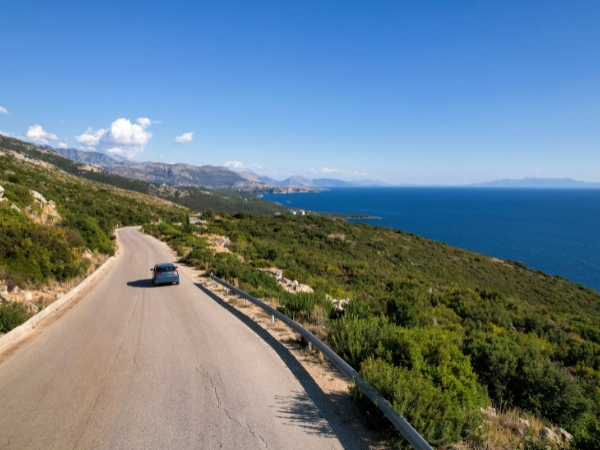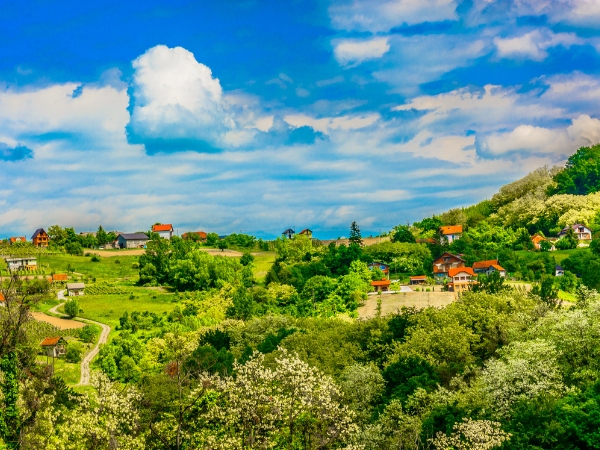
Dubrovnik’s Old Town is a UNESCO World Heritage Site famous for its well-preserved historic architecture. As you walk its gleaming limestone streets, you will see Dubrovnik architecture as a living museum of Gothic, Renaissance, and Baroque designs. This guide will help you discover these architectural gems, from grand promenades to hidden alleys. You’ll learn how centuries of history shaped each street and what to look for as you explore. Explore on foot, then rent a car in Dubrovnik to reach historic sites beyond the city walls.
Dubrovnik’s streets are the result of planning that dates back to the Middle Ages, shaped over time by disasters, rebuilding efforts, and strict design rules. As early as the 13th century, the city’s statute set out how streets should be laid out and how wide they should be. This created a clear, logical street network, with straight lanes linking homes to markets and the harbour.
As you walk through Dubrovnik, you can spot layers of architectural history. Some doorways and windows still show Romanesque and Gothic details from the medieval period. Elegant Renaissance palaces reflect the city’s golden age in the 15th and 16th centuries. However, the look most people notice today is Baroque. This is because a massive earthquake in 1667 destroyed much of the city, forcing Dubrovnik to rebuild almost from scratch.
After the earthquake, strict rules were enforced. New buildings had to follow the same height and design. Builders used local limestone for walls, roofs, and paving, creating the city’s signature pale colour. Main streets were paved with limestone as early as the 15th century, and centuries of walking have polished the stone until it shines.
Dubrovnik’s Old Town is full of charming lanes and plazas, but some stand out as especially rich in architectural beauty. Below, we highlight seven of the most beautiful streets in Dubrovnik that showcase different facets of the city’s design.
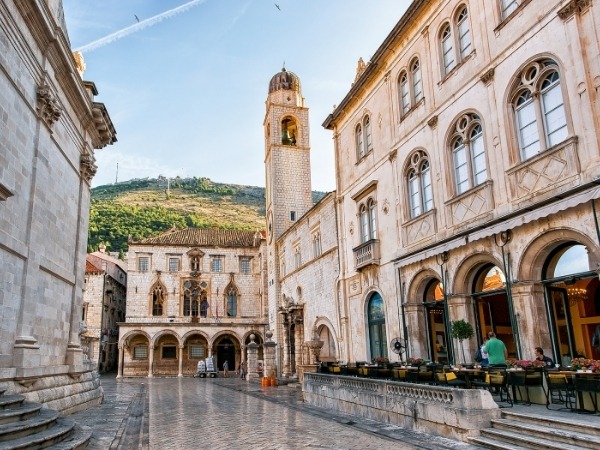
Stradun, also known as Placa, is Dubrovnik’s main street and the architectural heart of the Old Town. This broad limestone promenade runs straight for about 300 metres, connecting Pile Gate in the west with Ploče Gate in the east. Walking along it, you are crossing what was once a shallow sea channel, filled in during the 12th century to unite two settlements and form a single city centre.
The street’s appearance today is largely Baroque. Before that disaster, medieval houses with arches and decorative details lined the street. When most of them were destroyed, strict rules were introduced: new buildings had to be the same height and follow a similar design. This is why Stradun feels so balanced and orderly.
Stone houses line both sides, with shops at ground level and living spaces above. Underfoot, the limestone paving is smooth and glossy, polished by the footsteps of centuries. Look closely to spot a subtle design detail where two different paving patterns meet in the middle.
Stradun is also packed with landmarks and things to see in Dubrovnik. At the western end stands Onofrio’s Fountain, built in 1438 to supply the city with fresh water, next to the Franciscan Monastery, featuring its historic cloister and ancient pharmacy. At the eastern end, Luža Square opens up, dominated by the Clock Tower and Orlando’s Column, a long-standing symbol of the city’s independence. Nearby are the Sponza Palace and the Church of St Blaise.
Just one block north of Stradun lies Prijeko Street, a narrow lane that reveals a more personal side of Dubrovnik architecture. The street runs parallel to the main promenade about 50 metres uphill and feels distinctly medieval in scale. It is much narrower than Stradun, barely wide enough for a cart, and lined with tall stone houses that form a canyon-like passage. As you walk along, the street bends and is cut by steep alleys that climb towards the city walls.
Most buildings along Prijeko were rebuilt in the Baroque period after the 1667 earthquake. Look closely at doorways to see pointed Gothic arches or carved stone decorations. Upper floors often feature small stone balconies and traditional green wooden shutters. Prijeko Palace partially survived the earthquake. Its medieval lower walls endured, and later restoration recreated its 15th-century upper floors.
Historically, Prijeko was a practical residential and commercial street. Merchant families lived above while shops and taverns operated at street level, a layout well suited to a trading city. That tradition continues today. Restaurants, wine bars, and artisan shops fill the ground floors, with apartments and small hotels above. In the evening, tables spill into the lane and lantern light softens the stone.
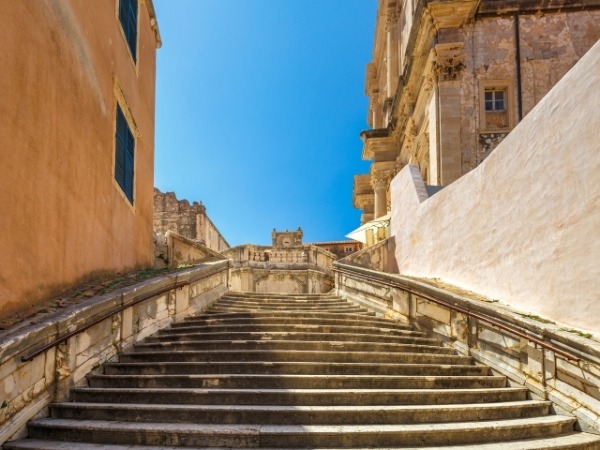
One of the most dramatic architectural scenes in Dubrovnik is the Jesuit Stairs and the small square at their summit, Poljana Ruđera Boškovića. Standing in Gundulić Square and looking uphill, you’ll see the elegant Baroque staircase rising in a graceful curve. Completed in 1738, the staircase has 136 stone steps, inspired by Rome’s famous Spanish Steps. The wide lower steps and flowing terraces create a feeling of movement as you climb.
The stairs were built to link the lower city with the Jesuit complex above. As you ascend, the busy market fades behind you, and the façade of St. Ignatius Church reveals itself. At the top, you step into Poljana Ruđera Boškovića, named after Dubrovnik’s celebrated scientist Ruđer Bošković. The square is small, often referred to as Jesuit Square.
Dominating the space is the Church of St. Ignatius of Loyola. Built between 1699 and 1725, it is a masterpiece of High Baroque architecture. The interior is richly decorated with illusionistic frescoes and a grand altar. The exterior is refined and balanced, with a curved gable and statues of saints. Alongside it is the former Jesuit college.
At the foot of the Jesuit Stairs is Gundulićeva Poljana, a lively Baroque market square. The word "poljana" means an open square, and this space only emerged after the 1667 earthquake. Over time, it evolved into the city’s main open-air market.
Architecturally, the square is framed by Baroque-era buildings from the late 17th and 18th centuries. On one side, the Jesuit staircase and St. Ignatius Church rise dramatically above the space. On the other side, stone townhouses with shops at ground level form a harmonious enclosure.
While the buildings share Baroque proportions and simplicity, each has small, individual details, such as carved windows or family crests. At the center stands a bronze statue of Ivan Gundulić, a 17th-century poet from Dubrovnik, erected in 1893. Reliefs on the pedestal depict scenes from his epic poem Osman.
Every morning except Sunday, vendors fill the space with wooden stalls and umbrellas, selling fresh fruit, vegetables, lavender, dried figs, local rakija, and souvenirs. For anyone interested in sightseeing in Dubrovnik, Gundulićeva Poljana offers history, architecture, and a genuine glimpse into everyday life in the Old Town.
Venturing into the southeastern corner of Dubrovnik’s Old Town, you’ll discover Pustijerna, the city’s oldest residential quarter. The streets are narrower, quieter, and more irregular, shaped by centuries of adaptation to rocky terrain rather than strict planning. Here, twisting alleys, stone arches, and hidden courtyards create a deeply medieval feel.
Pustijerna is archaeologically significant because it preserves Dubrovnik’s earliest layers of settlement. Excavations suggest this area may have been inhabited as early as the late Roman or Byzantine period, possibly forming the nucleus of the original town before Ragusa expanded. The Church of St. Stephen is located along Stulina Street. First mentioned in the 10th century, its remains, such as parts of apses and foundations, likely date back to the 6th or 7th century. These fragments are still visible today, embedded in later buildings.
You’ll also encounter historic noble residences that hint at Pustijerna’s former prestige. The Skočibuha Palace, a 16th-century merchant’s home, survived the earthquake. It still displays late Gothic and Renaissance details such as ornate windows and carved stone portals. Nearby palaces with Gothic features reinforce the idea that this was once the home of wealthy families.
Today, Pustijerna is mostly residential and blissfully calm. Laundry hangs between windows, cats nap on warm stone steps, and locals pass quietly through the alleys. Small churches, such as Our Lady of Kaštel, are situated against the city walls.
In a city famous for narrow lanes, Široka Ulica is an exception. Running east to west through the western part of Dubrovnik’s Old Town, this street is broader than its neighbours. Široka Street was designed as a functional artery, created to support the city’s food supply.
At the northern end of the street is Rupe, the former state granary. In medieval Dubrovnik, grain was crucial for survival, particularly during sieges or years with poor harvests. Much of it was imported by sea, then transported uphill from the harbour to the granary. Široka Street was widened to allow carts loaded with grain to move quickly. Today, Rupe houses an ethnographic museum, where you can still see the underground silos carved into rock.
The buildings are mostly modest stone townhouses from the 17th century, rebuilt after the earthquake under strict Baroque regulations. You’ll notice uniform heights, simple façades, rectangular windows, and subtle Baroque details like plain cornices. These were homes for merchants and artisans.
At the eastern end of the street is the Domino Church (Church of St. Ignatius “Domino”). It was originally founded in the 15th century and rebuilt in Baroque design after the earthquake. Nearby is the Marin Držić House, once home to Dubrovnik’s most famous playwright and now a small museum.
Running east to west through the heart of the Old Town, Ulica od Puča is one of Dubrovnik’s most historically important streets. The street runs parallel to Stradun, just one block to the south, linking the area near Gundulić Square with the western side of the Old Town close to Pile Gate.
As you walk along, notice the grand stone portals, refined window frames, and carved family coats of arms above doorways. These small shields once announced which noble family lived inside. One standout building is the Pucić Palace at the end of the street near Gundulić Square. This elegant Baroque palace is now a boutique hotel. It reflects the restrained luxury of Dubrovnik’s elite, with clean lines, fine stonework, and subtle decorative details.
Ulica od Puča was also a commercial centre. Wealthy residents often ran businesses on the ground floor while living above. The street later became known for its goldsmiths and jewellers.
The Serbian Orthodox Church of the Holy Annunciation was built in 1877. Its Neo-Byzantine façade stands out among the Baroque houses, reflecting the city’s diverse communities. Throughout the street, you may spot older Gothic windows or Renaissance details preserved within later buildings.
Dubrovnik’s streets are expressions of the city’s architectural evolution and resilience. From the medieval alleys of Pustijerna to the Baroque symmetry of Stradun, each street tells part of Dubrovnik’s story. By exploring them, you’ve walked through different centuries. So when you visit, don’t just stick to the main drag; explore beyond the main routes. Turn up that narrow stairway, wander into that quiet courtyard, and peek into old doorways.
If you plan to venture outside the Old Town and explore the surrounding countryside, you can rent a car in Dubrovnik with Final Rentals. Booking a car online is fast and simple. Select Dubrovnik Airport as your pickup location, enter your travel dates, and choose a vehicle for your trip. Book and manage your car rental at any time. Download the Final Rentals app on Google Play and the App Store.